

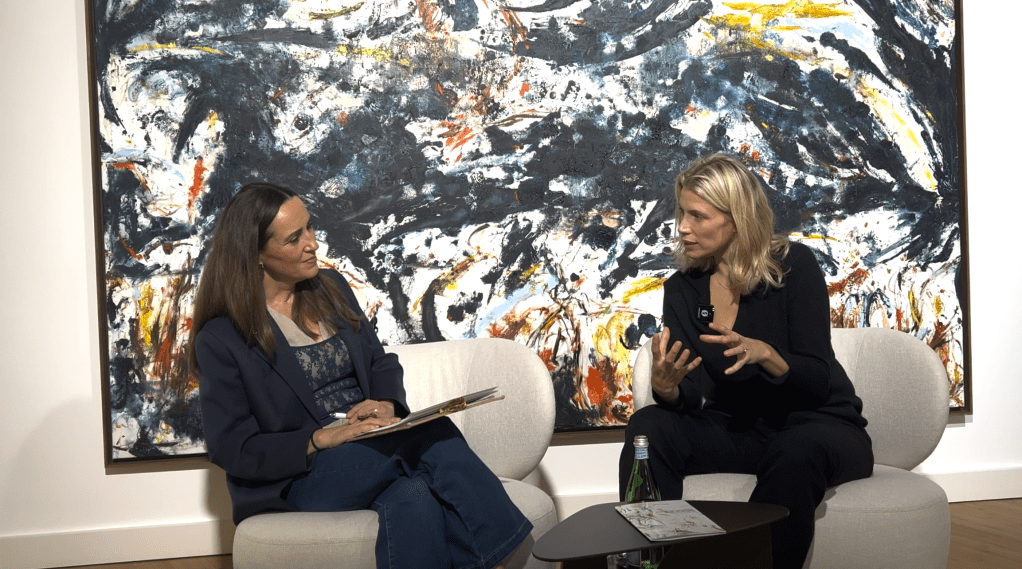
Marie de Villepin’s work is in permanent va-et-vient, oscillating between the angelic, the spiritual, the delicate, and, on the opposite pole, the demonic, the brutally real, and the rough and chaotic. Whether as a model for Givenchy, or as a musician with the band PINKMIST, or yet again, as a critically acclaimed and internationally recognized artist, everything Marie de
Villepin produces is somehow charaterized by this paced, rhythmical voyage she takes us on, where we are confronted with the good and the bad, and everything in between.
The daughter of a diplomat, Marie was socialized with total immersion into the cultures of India, the United States, France, and also China, through mentorship of iconic artists like the Zao Wo-ki. She brings into her work the rich understanding and sensitivity of a Third Culture Kid. She combines her experiences from the world of music and fashion with a well-rounded education and a natural, profound intellect.
Her paintings tell stories to a moving harmony of colors, shapes and drawings. Her paintings express her inner music and materialize on the canvas the writings of the brushes, knives and fingers with which she paints.
I was surprised to find a gentle, kind, and generous interview partner with a lot to say, but also very eager to listen and discuss. I was equally impressed by her art and by her person.
Marie de Villepin had the opening of her first solo exhibition in Germany at the Galerie Melbye-Konan on Friday, October 10th. The collection is called “Visions of Collisions” and it can be visited at the gallery at Mittelweg 169 in Hamburg until January 31st 2026.
Here are some excerpts from the transcript of our exchange:
Dr. J: Marie, as the daughter of a famous diplomat, you bring with you the travel and cultural experiences of a Third Culture Kid. You have been socialized with exposure to various cultures, from the cultures of India, the United States, France, but also China, through mentors like the late French-Chinese artist Zao Wou-Ki, who actually left you his tools and brushes, and of course through your family’s gallery, the Villepin Gallery, run by your brother. […] Roland Barthes maintains that artists rely on their culture’s visual language of colors, forms, and brushstrokes, but you have been influenced by so many cultures. In what way do your paintings reflect the cultures that have shaped you, and where can we maybe recognize the impact of these cultures, especially in your large-scale works?
MARIE: That’s a very deep and thorough question for the first question.
Dr. J: I like to dive right in.
MARIE: No, no, no, problem. Indeed, I was born in the U.S., and I was raised in India, and (…] I think those cultures are very much within me, and I carry them. […] You speak about color, form … I think it’s also music. I’m first and foremost a musician, and painting came as a second way to express myself. And it became my soul language! And I think in painting I’m able to gather all the different influences and try to reshape and rebuild on a blank state. And it’s the same sort of practice, like always going back to that blank canvas with a new appreciation and with all this different baggage. […] I think we are all very much multi-layered, and I know it’s a great advantage and a strength to be in a different culture/background, and hopefully it translates into my painting.
Dr. J: Okay. So, let’s go to these two aspects of your work. So, all your work, already as a Givenchy model, where you were the face of the campaign “Ange ou Démon,” to your work as a musician [… and] in the past 10 years, your work as an internationally renowned artist, who has presented exhibitions all over the world – all of your work always has this va – et – vient, between the beautiful, the tender, the delicate, and on the other hand, the almost evil, disturbing, destructive, right? […]
MARIE: […] I love the edge. It’s something that is very much a part of my personality. I know I enjoy the destruction in my work, and when I see what’s going on around the world, and of course I’m very much in tune with the geopolitics and the different conflicts that are plaguing our sad, beautiful world, I can’t escape that feeling. And so, that’s why I think it’s very important for me to balance it. So, whenever I have those tendencies, those lines that come through in my art, I always need to balance it out with something. And you were speaking about form, and Roland Barthes at the beginning, and of course, it reminds me of Cy Twombly and […] the beautiful text […] he wrote on him. And for me, color informs the form. It is very much […] shaping my field, and in that way, I’m of course borrowing from all the lineage from the New York School, whether it be Helen Frankenthaler, or Joan Mitchell, Philip Guston, or even de Kooning. So, I’m very much inscribing my work in that lineage, because it spoke to me from a very early age. I was privileged enough to go through many different art studios as a kid, because my parents were collectors. And […] a lot of friends of theirs were artists, […] like Zao Wou-Ki [whom] you mentioned. But, I can also talk about Anselm Kiefer, Miguel Barceló, Roberto Matta … So, I think it has very much shaped my unconscious.
Dr. J: So, let’s go into […] this movement and rhythm that you also incorporate into your work. And let me […] mention Hélène Grimaud, the pianist who has synesthesia, and she actually sees the notes that she plays as colors. So, B minor is blue, E flat major is green, etc. […] And you speak of notes, and rhythms, and movement in your paintings […]
MARIE: I think, unlike Hélène Grimaud, I’m a frustrated musician. I had several rock bands, and I never put out a real project, like it was always embryos. And I think a lot of my tension as an artist comes from that. […] In many of the paintings and drawings are titles, lyrics from songs that I wrote. And so, I’m slowly releasing my various albums and songs with my paintings and my drawings. So for me, it’s very much my channel.
A Short Question-Answer Session with French-American Artist MARIE DE VILLEPIN
Dr. J: More significant to your work, New York or Paris?
MARIE: New York.
Dr. J: More difficult to deal with, Dad’s career as a diplomat, or Mom’s career as a sculptor?
MARIE: Definitely Dad.
Dr. J: Most interesting to paint with: brush, knife or fingers?
MARIE: Fingers.
Dr. J: Most dear to your heart, PINKMIST, the painting or the band?
MARIE: For sure the band.
Dr. J: If you had to paint with only one color, what would it be?
MARIE: The non-color, which is black.
Dr. J: The best sound to listen to when painting?
MARIE: Hard rock.
Dr. J: Most annoying about being beautiful?
MARIE: It’s a privilege, and it fades quick. For me, it’s from the inside;
I’ll give you the Indian answer.
Dr. J: And how do you want people to interact with your art?
MARIE: I want them to feel, no matter what it is. Like I said, sadness, or rejection, or joy. I want them to feel something, and that’s what art is for!
DR. J: Your saddest painting?
MARIE: You know, if I tell you the truth about PINKMIST, the painting… It’s actually pretty sad, because it’s a painting I made when l arrived back in Paris after Covid. And I was staying in the first “Poush” next to Clichy, and it was a tower. And Push is actually a very interesting artist incubator, where hundreds of artists gather from different nationalities, different practices, and work together on the same premises. And the studio that I occupied actually at the time in that tower was on the 15th floor. And all I could see was… those beautiful sunrises, sometimes, sunsets. And that studio belonged to a painter called Bruno. And he jumped from the tower. He jumped from the window, from my studio […] And “pink mist” has two significations. It’s a military term, when a sniper shoots a guy away, the impact of the bullet with the skull, that’s called a “pink mist.” And it was also used during the World Trade Center, when people would jump from the World Trade Center, and it would be called a “pink mist.” So, it has a double entendre that is very deep. And when I arrived in that studio and I felt Bruno’s presence, all I could paint was those colors, was with those two colors: pink and blue. […]
Dr. J: Thank you for sharing that.
THANK YOU, MARIE DE VILLEPIN FOR THE INTERVIEW!
Marie de Villepin
mariedevillepin.com
melbye-konan.com
 Cultureum
Leave a comment