

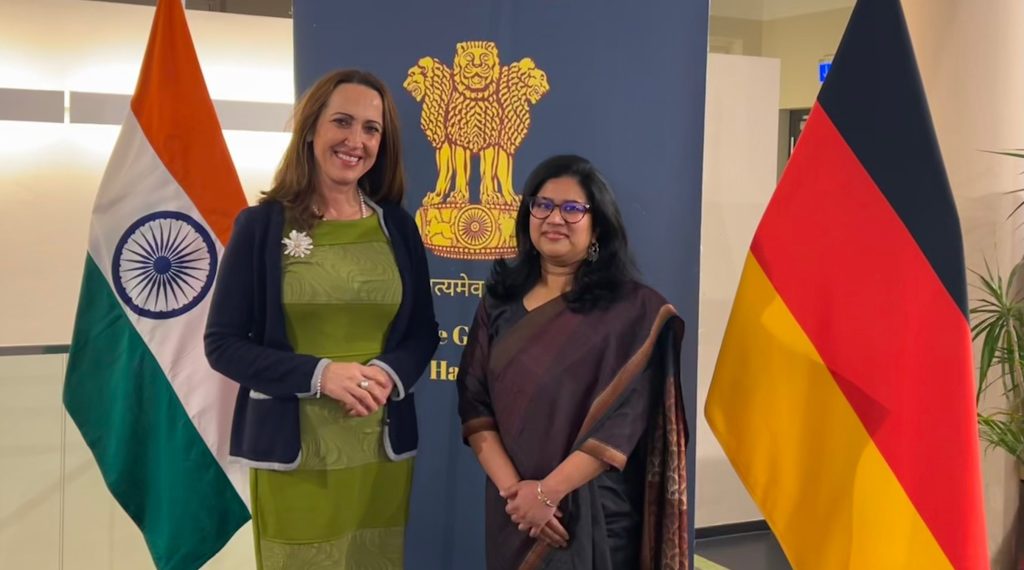
It was at the recording of my live podcast episode on the role fashion and cuisine have played in diplomacy since the reign of Louis XIV that I met Soumya Gupta, then newly appointed Indian Consul General to Northern Germany, who had not long before arrived to Hamburg.
The former French Consul General Valérie Lübken was my honored interview guest and had invited Ms. Goupta, as well as other members of the diplomatic corps to the event.*
After the interview, Ms. Gupta and I engaged in a lengthy and very interesting conversation about Ganesha, the Hindu deity with an elephant’s head. Ganesha is believed to be able to remove obstacles and is generally associated with new beginnings, as well as wisdom and success. An Indian Professor from New Delhi, whom I had met while working at Leuphana University Lüneburg, had taught me a mantra that can be used to pray to Ganesha, and I still chant it sometimes when facing problems that don’t seem to let themselves be solved, or when embarking on a new project or endeavor. The mantra goes: “Om Shri Ganeshaya Namah,” and it means, “I bow down to Lord Ganesha.”
The Indian Consul General was intrigued by my interest in India, and she and her staff would subsequently invite me to the Indian Consulate General for several festivities and celebrations.
In the three years since I first met Ms. Gupta, I have had the great honor and privilege of partaking in India’s Republic Day, Independence Day, and in India Week Hamburg. I have enjoyed several yoga sessions as well as International Day of Yoga through the consulate. This is how I discovered sitar music and how I got to know traditional Indian dance styles such as Bharatanatyam, Odissi, and Kathak. This is where I have enjoyed the work of numerous Indian artists living in the area. This is how I tried out various Indian dishes and desserts. And this is how I got to engage in many insightful and thrilling conversations with delightful people with Indian ancestry or who have lived or extensively travelled through India.
In my experience, the Indian Consulate General has been a haven of sorts that promotes Indian culture and traditions, but also encourages dialogue, mutual respect, and understanding. I am not of Indian descent and I have never visited India (not yet!). But I have always felt welcomed with open arms by everyone at the consulate. Everyone has always been eager to share with me the intricacies of what makes them Indian and what they cherish the most about their country of origin. There is a warmth and friendliness that is contagious. There is a gentle politeness and willingness to listen and entertain questions as well.
As one of the last major actions of her 3-year-term to Norther Germany, Soumya Gupta hosted the 77th Republic Day of India at the Consulate General, commemorating the 77th year since the adoption of the Indian constitution, and I was delighted to be allowed to participate. But somehow, I attended this event differently from previous ones. Because of former visits to the consulate, I felt at ease at the venue. Because of my former contact with Indian celebrations and cultural events, I was more open, more curious, even more eager to further discover. I was struck by a sensation of having to attend Republic Day and of having to pay attention to what was said, and wanting to be a real part of the festivities.
What I was feeling is something that occurs quite naturally once we gain a sense of belonging: to a place, to the company of certain people, to engaging in a certain activity, etc. This is something I have written about many times in connection with performing and visual arts. I often point out how people who are not already associated with the ballet or “regulars” at ballet performances, for example, will feel somewhat awkward their first time, and will only touch on the surface of a real, powerful, “ballet experience,” which comes about after repeated exposure.
Much of my research has centered around bringing all socio-cultural fractions of society together. I believe that cultural activities and celebrations offer a platform through which we can connect. But the matter is not that simple, because how we introduce the various members of society to these activities will make the difference in whether they truly foster a sense of unity or create an even greater divide. To throw Pierre Bourdieu’s concepts into the mix, we each bring differing social, cultural, financial, and symbolic capitals to the equation and will appreciate or engage in activities with differing enthusiasm and depth of understanding. To put it in simplistic terms: If I have been going to museums with my mother since I was a little girl, I will probably continue going to museums. As a result, I will feel comfortable in museums. I will know how to behave. I will feel accepted. I will know what to say, whom to greet, what to look at, what comments to make, etc. I will also know what to wear, where to get a snack, and how to combine this outing with my other interests. I will quite certainly have or make friends who also go to museums, and we will enjoy this activity together. And so on.
And this is what happened to me with the Indian Consulate General, where I did not automatically and obviously belong, and where I didn’t have a personal stake in being included. But the key lay in an initial connection with Soumya Gupta and a subsequent positive reinforcement of this feeling during each of my visits to the consulate. But the realization, the true connection and appreciation would come 3 years later, and I think this is important to underline, because cultivating cross-cultural awareness and broadening cultural consciousness does not occur overnight.
So, how did I experience my latest visit to the Indian Consulate General in Hamburg on the 77th Republic Day of India? And, with Soumya Gupta’s diplomatic term to Northern Germany slowly coming to an end, how do I envision my future connection to the Indian community in Hamburg, and to India itself?
As I already mentioned, I went to the consulate this time, feeling like I belonged, and I paid attention like a family member would. And here are the things that struck me as most interesting:
I found it touching how Indians abroad stood “at attention,” showing absolute and full respect for the flag unfolding ceremony and the singing of the national anthem, the Jana Gana Mana. It was fascinating to find out that the first time the current Indian anthem was sung as the official song of an independent India was not in India, but in fact in Hamburg, Germany! In September of 1942, as part of the meeting at the Hotel Atlantic that marked the establishment of the German-Indian society, this new national anthem was performed. This revealed to me a timeless, symbolic connection between India and Germany that I had not been aware of before.
Because of this new-found knowledge, I eagerly followed the news the next day about Indian Prime Minister, Narendra Modi, and the President of the European Commission, Ursula von der Leyen, meeting at the 16th India-EU Summit. I took great interest and pride in the developments of the summit: the signing of the India–European Union Free Trade Agreement (the India–EU FTA), of the Strategic Agenda 2030, and of the Mobility Memorandum of Understanding (MoU). These terms and these agreements would not have meant much to me in the past. I will not shy away from admitting that I had to look up each and every one of them to know what exactly they entailed. But you see, as a “regular” at the Indian Consulate General, I wanted to know and I wanted to care, and so I took the time to find out.
In case you are not quite familiar with these significant agreements between the EU and India, here is what they mean. The India–European Union Free Trade Agreement (the India–EU FTA) is a political and economic agreement that reduces tariffs on 90% of goods traveling between the EU and India, allows for all sorts of privileged agreements for trade with pharmaceuticals and chemicals, textiles and furniture, or machinery, and also allows for specialists and skilled professionals to more easily travel and work between the EU and India. This is a tremendously powerful agreement!
The 2030 Agenda is no less significant, because it aims to jointly fight for economic, environmental and social prosperity and dignity for all fractions of society worldwide!
The Mobility Memorandum of Understanding (MoU) vows to collaborate through knowledge and research, through solutions developed together, through joint innovation and development. The MoU effects not only governments and organizations, but also universities and “normal” people. It facilitates student exchanges. It allows for sharing of talent and ideas in all areas of life.
And all this, I would have perhaps glossed over in Die Zeit or Der Spiegel, but it would not have registered the same way; it would not have meant anything to me personally.
But my impressions from the 77th Republic Day of India do not stop at the flag unfolding ceremony and the singing of the national anthem. There would be more singing and chanting that would resonate with me. I very much enjoyed how all the expat Indians gathered at the Consulate General also sang the Vande Mataram together, and I learned that this poetic song has great emotional significance (which you could definitely feel in the room), and praises, or gives thanks to a beautiful Mother, a personification of the Motherland.
At two instances, there was also a loud cry of something I did not understand, and I was almost startled when this statement was pronounced by all Indian nationals present, in unison, and with such power. I had to specifically enquire as to what had been said, but you see, I felt comfortable enough and curious enough to do so. Beforehand, I might have just written it off as a peculiarity that I was happy enough to ignore and not understand. When I asked as to what the loud cries had meant, I was told that it was a sort of a motto or chant in appreciation and support of India. It goes: Bharat Mata ki Jai and depending on whom I asked, I was told that it meant something like “Victory to Mother India” or “Long live Mother India.”
At the celebrations for the 77th Republic Day of India in Hamburg, Consul General Soumya Gupta shared the address to the nation of Prime Minister Narendra Modi as well as her own reflections and remarks.
I found it refreshing to hear how much the security of the people, efforts to reduce poverty, and the protection of the environment was emphasized. I found it touching that all members of society were specifically mentioned and thanked, from the farmers (especially organic farmers), to the doctors, nurses, teachers and other individuals working in the public service sector, to scientists, people working in business, IT, or industry, to artists, writers, and crafts persons, to people who contribute through sports (with an emphasis on cricket and chess), and so on. I found it important that overseas Indians were mentioned and that the empowerment of women as a goal for the future was underlined.
I did, of course, also learn one or two more things about India, and some of this information might have been passively in my mind somewhere, but the impact of what it means hadn’t reached me. I was reminded that there are 1,5 billion Indians in the world, that the country has the fastest growing economy, which is soon to become the 3rd largest economy in the world, and that India is the country with the largest young population. This is tremendous, and the importance of these facts hit me, as I stood in the crowd during the celebrations for 77th Republic Day.
I also learned that the Indian constitution exists in all of the official 22 languages recognized by the Indian government. 17 of these languages also appear on the Indian currency notes, or bank notes. I was absolutely fascinated by this. Imagine having 17 languages on the money you pay with. What an attest to diversity! What a challenge well met for getting along and showing respect for each other.
Now, here is a little detail that also caught my attention. The General Sewing Data (GSD) was mentioned, and since I did not know what this was, I looked it up, only to find out that with it was meant a system that measures how long it takes to pick up a piece of material, handle it, use the machines, etc. in order to make production of garments most efficient and cost-effective. Although this system was not invented in India, it has been in use there since the 1990s. The NIFT (National Institute of Fashion Technology) also adopts it, and there is apparently great pride in India’s use of this system, since it has allowed India’s fashion and garment industry to flourish.
What I found most significant, though, was the statement that India is praying for World Peace. This was emphasized in Prime Minister Modi’s address to the nation, in Consul General Gupta’s speech, as well as in her conversation with me at the reception. India is working to facilitate World Peace. India is invested in and committed to all initiatives that drive towards World Peace.
Interestingly, my evening ended with a conversation that would embrace this sentiment on a personal level. There is an absolutely lovely Indian lady, whose company I always try to seek out whenever I get the chance to run into her at the Indian Consulate General, because I admired her subtle, elegant style and her great, ageless beauty. But our conversations in the past were mere polite exchanges about one of the dance acts or about the food. This time, however, I had the great pleasure of engaging in a longer exchange that centered around the abundance of languages in India and how this affects people. The lady told me that she and her husband each brought a different Indian language to their marriage, and that they would speak English and German at home. The conversation then turned to child rearing and how we can instill certain cultural traditions in our children. And my conversation partner explained to me how she tried to teach her children about India and how they appreciated Indian customs and cuisine in their home. But then, she got quite pensive and told that in the end, her intent was not to raise Indian or German children, but to simply raise her children to be decent human beings with a sense of who they are and where they come from, but even more importantly, with a sense of right and wrong, and a sense of character and dignity.
I have had three years of exposure to Indian culture thanks to the Indian Consulate General in Hamburg. This has allowed me to learn about India and to come into contact with Indians living abroad. It is comforting and encouraging to witness how people can appreciate their ancestral culture and take pride in their national origins. It is heartening to be made a part of their appreciation and welcomed into their celebrations. And it is quite reassuring to be able to say, that while we can enjoy a rich diversity of traditions, experiences, and emotions, based on my experiences at the Indian Consulate General in Hamburg, at the end of the day, we are all just trying to get along and are all striving for a unified goal of peace and harmony.
Thank you to Consul General Soumy Gupta for including me in so many of the activities and celebrations of her country over the past three years. Thank you to the Indian Consulate General for welcoming me with open arms.
I hope this marks only a beginning. I look forward to continuing to explore and appreciate Indian culture in Hamburg, while sharing my personal impressions through articles, interviews, and future podcast episodes over the years to come.
*Live podcast episode with former French Consul General Valéry Lübken on the role fashion and cuisine have played in diplomacy since the reign of Louis XIV:
The podcast episode in German is entitled: “Mode, Küche und Diplomatie,“ and the discussion and review of the episode in English with Georgetown University Professor Myriam Vukovic bears the title: “Fashion, Cuisine, and Diplomacy.“
Both episodes can be found on the PODCAST, Language and Culture with Dr. J, available on Spotify, Apple podcast, and on cultureum.com.
 Cultureum
Leave a comment